Food safety

Food safety

Last updated

Overview

Practicing food safety is important to protect students and staff from the risk of foodborne illness (also known as food poisoning). Foodborne illness is most often caused by eating food that has been contaminated. Improper food handling, storage, cooking and cooling can all contribute to a foodborne illness outbreak.

Fortunately, most foodborne illnesses are preventable. This section will address common questions regarding food safety permits, food safety training, and how to prevent foodborne illnesses.

Please note that this guidance is not comprehensive and does not replace food handler training. The intent of this guidance is for foods prepared within schools (onsite) as well as serving, handling and storage of food from approved sources (e.g., restaurants/caterers).


Do I need a food service establishment operating permit?

For most school food programs preparing lower risk foods, a food service operating permit is not required, and they likely would not fall under the purview of the Food Premises Regulation. In a school environment where food is prepared onsite, a permit is likely only required when potentially hazardous foods (PHFs) might be sold or served to the public (e.g., at a public event or in a cafeteria). With that said, a risk assessment should be completed by an environmental health officer (EHO) to determine whether a permit is required. Factors that EHOs consider in their assessment include but are not limited to:

  • What kind of foods are being prepared/served (distinguishing between lower risk and higher risk foods)
  • Volume or quantity of food prepared/served
  • Kitchen set-up (layout, construction and equipment)
  • Food preparation steps (e.g., simple or complex)
  • Whether food is prepared at a separate location (i.e., caterer/restaurant) – If so, how is it transported? Is the temperature adequately controlled and monitored?

PHFs are foods that can support the growth of disease-causing micro-organisms or the production of toxins. Example of foods that are considered PHFs include meat, poultry, fish, seafood, milk, yogurt, cut fruits & vegetables, cheese, eggs, and cooked rice. Specific storage and handling are generally required for PHFs, such as refrigeration (4°C or lower), freezing (-18°C or lower), or hot holding (60°C or higher), as well as monitoring of best before dates, if applicable.


Do I need FOODSAFE training?

Although your school meal program may not require a food service operating permit, food safety should always be a top priority – especially when preparing and serving food to vulnerable populations, which include children. Completion of an approved food handler training program such as FOODSAFE Level 1 (or an equivalent) is strongly recommended for most cases where food is prepared and served to students, particularly if this is part of an ongoing program.

At a minimum, it is recommended that all staff in schools purchasing, preparing and serving foods to children take the free “Caring about Food Safety” course.

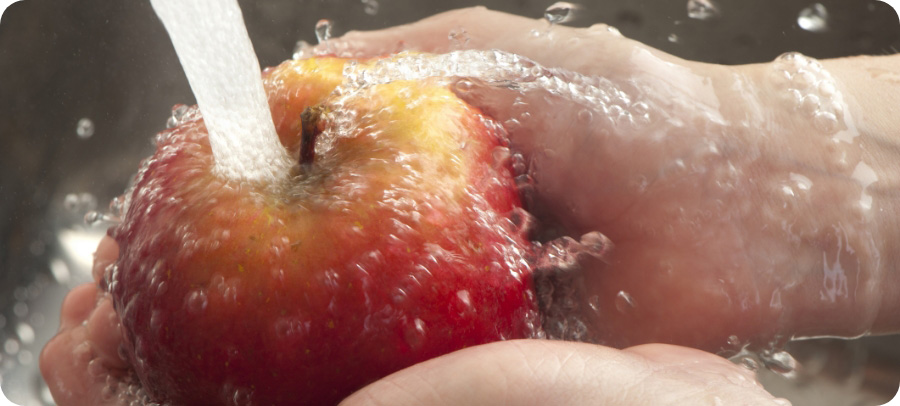
Close up of hands washing an apple.

Food safety practices

Hand hygiene

Good hand hygiene is critical to protecting everyone from foodborne illnesses. Hands must be washed as often as necessary to prevent the contamination of food, or after any activity that may contaminate food. For example, you should always wash your hands before preparing or handling any food, and after touching raw meat, poultry, fish, and seafood, and after using the washroom. Note that any aprons/coverings need to be removed before going to the washroom. Wash your hands with warm, soapy water for at least 20 seconds. Gloves and hand sanitizer may be used as an extra precaution, but these do not replace handwashing. All handwashing areas should be equipped with liquid soap and single-use paper towels.

Sick food handlers

If a food handler is experiencing symptoms such as diarrhea, fever, nausea, vomiting, jaundice, sore throat with fever, it is important to avoid preparing and handling food as they are more likely to spread pathogens that can make others sick. Additionally, if a food handler has cuts or wounds on their hands, they should be completely covered by finger cots or latex-free gloves.

Kitchen and utensils

Proper cleaning and sanitation of kitchen surfaces (especially food contact surfaces and frequently touched surfaces) and utensils helps prevent the spread of bacteria:

  • Always clean and sanitize any surface such as sinks, preparation areas or containers immediately after they have been in contact with raw meat, poultry, fish and seafood
  • Do not reuse plates or utensils that have touched raw foods without washing them first in a dishwasher or in warm soapy water
  • Use one cutting board for ready-to-eat foods, and a different one for raw meat, poultry, fish and seafood
  • Avoid sponges as they are hard to keep bacteria-free; change dishcloths daily
  • Clean, then sanitize your countertops, cutting boards and utensils before and after preparing food. Use a kitchen sanitizer for food contact surfaces (follow the directions on the container) or prepare a bleach solution in a labelled spray bottle (you can use a ratio of 5 ml of commercially available bleach to 1L of water) and air dry

Storing and cooking food

One of the most important phrases in food safety is “keep hot foods hot and cold foods cold” to avoid what is called the danger zone. When foods are in the danger zone, bacteria can multiply very quickly.

The danger zone is between 4°C to 60°C where bacteria can multiply very quickly. To avoid the danger zone, keep hot foods hot at or above 60°C and cold foods cold at or below 4°C. Please see the “Cooling Foods” section below for further important information on this topic.
When serving food at room temperature, for example a platter of sandwiches, avoid the danger zone by putting any uneaten food back in the refrigerator within 1 hour. It is best to keep PHFs refrigerated until they are ready to be served. Raw whole (uncut) fruits like bananas, oranges, apples, plums, peaches, and pears can be left out at room temperature.

When storing food:

  • Set your fridge at 4°C (40°F) or lower
  • Set your freezer at -18°C (0°F) or lower
  • Hot hold foods at 60°C or higher
  • Use a calibrated thermometer to monitor fridge, freezer and hot holding temperatures.
  • Place raw meat, poultry, fish and seafood in a sealed container on the bottom shelf of your fridge – this prevents raw juices from dripping onto other food
  • Store cut fruits and vegetables in the fridge
  • Refrigerate or freeze raw meat, poultry, fish, seafood and leftovers immediately
  • Cook raw meat, poultry, fish and seafood by the “best before” date, or no more than 2 to 4 days after buying it
  • Freeze raw meat, poultry, fish and seafood if you do not plan on cooking by the “best before” date
  • Use the “first in, first out” stock rotation principle, meaning use oldest products first – this prevents food spoilage

When cooking food:

The only way to ensure food is properly cooked is to check the temperature using a calibrated food-grade thermometer (instant digital thermometers provide the most accurate readings). Harmful bacteria can only be killed by proper cooking.

Different foods have different internal cooking temperatures; most are fully cooked when they reach an internal temperature of 74°C. For a complete list of foods and what temperature is recommended, refer to safe cooking temperatures.

  • When cooking meat, insert a clean and sanitized thermometer into the thickest part of it. Make sure it is inserted all the way to the middle and does not touch any bones.
  • For hamburgers, insert the thermometer into the side of the patty, all the way to the middle.
  • As food can cook unevenly, when cooking several pieces of meat, make sure to check the internal temperatures of the thickest pieces.
  • Use different plates for raw meat and cooked meat to avoid contamination with raw meat juices.
  • Clean your thermometer in warm, soapy water between each temperature reading.
  • Microwave ovens heat food unevenly. Food should be stirred, and temperature checked at multiple spots when reheated in the microwave.
  • Keep cooked food hot until it is served. If the food is intended to be served the following day, it should be cooled according to the guidance in the next section, then refrigerated immediately and reheated to 74°C before serving.

Cooling foods:

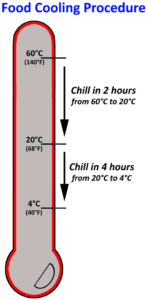
Food cooling diagram.

Cooling cooked foods is critically important to preventing foodborne illness. Cooling large batches of food can be tricky because it can take a long time for the interior to cool down. This is when spore-forming bacteria can germinate, grow, release toxins and cause food poisoning, even if the food is reheated. That is because many toxins are resistant to cooking.

Cooked foods must be cooled within 6 hours, in two steps:

  • Within the first two hours, the temperature of the food must drop from 60°C to 20°C,
  • Within the next four hours, it must drop from 20°C to 4°C.

Monitoring the temperature of the food during cooling.


Tips

  • To cool large pots of soups, stews or pastas pour the food into a large, shallow rectangular dish to rapidly cool the food down, or use an ice-wand to stir and bring down the temperature.
  • Portion food into smaller containers if possible.
  • Do not stack pans – adequate air flow is important for cooling

For more information about food safety requirements, please review the Public Health Act’s Food Premises Regulation, which outlines food safety requirements for processing, preparing and selling food. For examples of food safety plans, please visit Food Safety Plans: Examples (Government of B.C.). For summarized  food premises guidance, please visit BC Centre for Disease Control’s Food Protection Guideline.

You may find contact information for your health authority via these links: