Tongue-tie and tethered oral tissues

Tongue-tie and tethered oral tissues

Last updated

About tethered oral tissues

When a baby’s mouth is forming in the womb, the tongue, lip and cheeks are connected to the gums and jawbone with tissue called a frenulum. Everyone has a frenulum under their tongue, under their upper lip, and on parts of their cheeks. It is often normal and without associated medical problems.

When a frenulum impacts function, it is called a tongue tie (also known as ankyloglossia) and other oral ties (such as to the lip or cheeks) can be present. A frenulum is considered tethered or “tied” if a tight or restricted frenulum causes restriction in function for breastfeeding, eating, drinking or speaking. It is considered a normal frenulum if there is no restriction in function.

Tongue-tie or Ankyloglossia

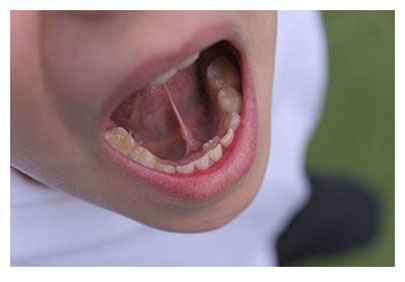
Eiffel tower tongue tie, underdeveloped jaw and crowding not enough space for adult teeth

Tongue-tie or Ankyloglossia, happens when the lingual (tongue) frenulum tissue that attaches the tongue to the lower jaw is too short or thick, limiting the full movement of the tongue and this impacts breastfeeding, eating, speech and oral hygiene (but not necessarily formation of dental caries). Current studies are also looking at the impact of tongue tie on facial growth and oral/dental development, as well as airway development and mouth breathing.

Photo above-right: tethered oral tissues may be associated with dental crowding and underdevelopment of the jaw

How do I know if my tongue frenum is restricted?

  1. Open your mouth as wide as you can, then lift your tongue up towards your top jaw and take note of how far the tongue can lift.
  2. Gently place your finger on the floor of your mouth (the area between your lower jawbone and the undersurface of the tongue) and try to lift your tongue again.

If the elevation is limited, you may want to consult a professional trained in tongue tie diagnosis and treatment to help you assess options for care, especially if you have trouble with things like chewing or swallowing food or drink, saying certain sounds, breathing issues or other dental concerns like crowding of teeth or baby teeth that do not fall out on their own.

Lip tie (or Labial Frenulum)

Lip tie (or Labial Frenulum) occurs when the lip (labial) tissue that connects the upper lip to the gums on the upper jawbone is too tight, thick, or short, which can impact oral development, and spacing of erupting teeth. Current studies are also looking at the impact of a lip tie on speech and breastfeeding difficulties.

Cheek tie (Buccal tie)

Cheek tie (Buccal tie) is when there is restrictive frenulum tissue from soft tissue of cheeks to the bony part of the upper or lower jaw. There are no current measurement systems available to categorize cheek ties. Research is ongoing right now to better understand the impact of these ties and whether they are necessary to treat.

Causes of tethered oral tissues

The cause of oral ties isn't always known. They can run in families (genetic factors) or may occur in babies who have other problems that affect the mouth or face (developmental factors), such as cleft palate or Pierre Robin Sequence. It also can just be a normal variation of development in the womb.

Symptoms of tethered oral tissues

Breastfeeding, eating, breathing and speech all use various combinations of oral muscles and structures in complex ways. Every person is different, so a tethered frenulum may cause a problem in one person, but not another, which makes it hard for medical professionals to make broad treatment recommendations on appearance. Not all ties are associated with every functional problem. Each patient needs to be looked at individually with a thorough examination that identifies functional problems and symptoms to come up with appropriate treatment recommendations. Current research is focused on identifying these functional problems and how they can be related to one or more restrictive oral ties.

Below are some of the ways that people with tethered oral tissue can experience health issues:

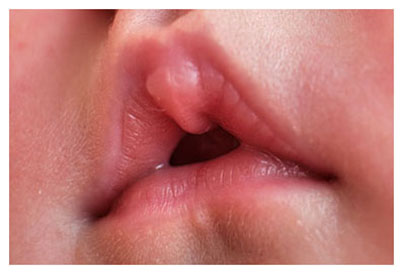
baby open mouth posture, u-shaped upper lip and lip blister
  • Breastfed babies may have trouble latching or staying on to the mother’s breast to feed, which can lead to poor weight gain and can cause issues with low breastmilk supply for the mother. Bottle-fed babies may have fewer feeding problems when there is a tie because it is generally easier to get milk from the nipple of a bottle than that of a breast. Babies can have trouble transferring or swallowing milk during breastfeeding or bottle-feeding.

Photo above-right: breastfeeding struggles and swallowing dysfunction may accompany open mouth posture, u-shaped upper lip and chronic lip blisters

  • Maternal nipple pain, prolonged feeding for the baby, short durations between feeds, and clicking noises are other common breastfeeding symptoms research has shown to be related to ties.
  • Reflux-like symptoms are common with oral ties in babies. This is because if the latch is not sufficient, the baby may be clicking and swallowing air (called aerophagia), which can lead to frequent or projectile vomiting and gassiness – this is not the same as acid reflux, even though it may look like it. Additionally, tension in the body can impact the digestive tract and lower body. Addressing oral ties in babies with aerophagia-associated reflux can help get babies off unnecessary acid reflux medicine or prevent the need from starting such medicine in the first place.
  • Babies, children, and adults may have an open-mouthed posture when they have oral restrictions. This may lead to a narrow upper jaw, dental crossbites or other tooth-crowding issues.
  • Young children may have difficulties with eating. They may gag/vomit when eating, be extremely picky or slow eaters, be unable to handle raw vegetables, unprocessed meats, crunchy foods and may hold food in their mouth or cheeks for prolonged periods of time.
  • Some older children and adults may have gaps or spaces between the front upper or lower teeth or have narrow dental arch development of the jawbones which may cause dental crowding and other orthodontic issues. Ongoing research is focused on determining which dental and occlusion issues are related to ties, and which may be caused by other factors.
  • Speech problems can be seen with tongue tie, because full mobility of the tongue is generally required to produce all speech sounds accurately. The most common sounds impacted are ‘s’ and ‘z’ (lisp), but ‘t’, ‘d’, n’, ‘l’, ‘r’, ‘ch’, ‘sh’, ‘zh’, ‘k’ and ‘g’ may also be affected. Some may be more difficult to understand or be unintelligible. It’s important to remember that even if there are other reasons for speech problems that tongue ties should also be considered for treatment to allow the patient the best chance at achieving normal speech.
  • Poor head and body posture can sometimes be related to tissue restrictions. Examples are skeletal asymmetries, head forward posture, torticollis in babies, or other body tensions.
  • Mouth breathing, sleep apnea, or other sleep issues may be related to the tongue or related to a combination of other mouth and face structures. Your doctors, dentist and health team can work together to help you resolve these symptoms because they could be related.

Tongue-tie symptoms may go unnoticed by patients and families and healthcare professionals in some cases. Tie-related symptoms may be incorrectly attributed to other factors if a proper evaluation for oral ties is not performed. Other times children and adults can compensate for the restriction with alternative mouth motions which may lead to other “compensatory” problems. Physicians, dentists, speech language pathologists, feeding therapists, occupational therapists, physical therapists and other healthcare providers who work with babies may be the first to notice signs or symptoms.

Diagnosing tethered oral tissues

There is no one specific specialist in oral ties. The International Consortium of oral Ankylofrenula Professionals (ICAP) Practice Guideline for Ankylofrenula Management advocate for a comprehensive examination of the oral structure and functional assessment, including examination of the appearance, movement and functional impact during breastfeeding, bottle-feeding, eating, drinking, breathing and speech production. In general, it is best to involve experts in functional, such as a lactation consultant for breastfeeding, a dentist of oral or dental development, a speech language pathologist or occupational therapist for swallow and feeding issues, a speech language pathologist for speech concerns, an ear nose and throat doctor (otolaryngologist or ENT) for breathing issues. Health professionals who have sought out extra training and experience in tethered oral tissues will be in a better position to recognize symptoms, diagnose, and treat patients with this condition. Often, a team of these and other health professionals are needed to reach a diagnosis to help you find treatment for the root cause of these issues.

white coated tastebuds and dimpled pull down indicate restrictive form and function affected by tongue tie

As an example, International board-certified lactation consultants (IBCLCs) are often the first ones to notice a functional issue as they are experienced in normal breastfeeding. The IBCLC will notice dysfunctional breastfeeding behaviours, and work with the dyad to maximize position and latch. After a complete breastfeeding assessment if there continues to be a functional issue the IBCLC will refer the dyad on to a surgeon (doctor or dentist) for further diagnosis and possible surgical treatment.

Photo above-right: white coated tastebuds and dimpled pull down indicate restrictive form and function affected by tongue tie

Your physician, dentist, lactation (or feeding) consultant or doctor will perform a physical examination of your child's mouth, look at the range of motion of the lip, tongue, and cheeks, and take a thorough history to understand his or her associated symptoms. In an older child or adult, they may check how the shape and movements of the tongue have contributed to normal or abnormal dental arch form, tooth spacing or crowding. In nature, “form follows function”, which means that the tongue is supposed to have a certain shape to allow it to successfully carry out all its duties, and for the rest of the mouth and facial skeletal structures to form properly. When there is a tether, there can be obvious and subtle findings that healthcare professionals can identify. Diagnosis should never be based on appearance alone.

How oral ties are treated

Depending on the age of the patient and the symptoms present for the tie(s), timing and type of treatment can vary.

In newborns with breastfeeding and latch concerns, the earlier a restriction is diagnosed and treated, the better the prognosis. However, a diagnosis can be made at any age. It is highly recommended that lactation or other feeding therapy support is provided in the lead up to a procedure and the recovery plan.

In infants, children and adults, it is recommended to utilize conservative, non-surgical techniques by working with speech, feeding, myofunctional or other types of therapists before considering surgical release options to optimize results of the procedure(s). This is because the longer a patient has compensated for these oral ties, the less likely a simple release will be sufficient to fix the problem, as the patient will need to learn the best way for their newly mobile tongue and mouth tissue to function. Also, by working with these therapists, its possible some problems may be resolved without having to consider a surgical option.

Modern surgical releases for these conditions usually involve advanced techniques with lasers or sharp surgical tools to preserve normal tissue, reduce scarring, and return to normal function as fast as possible. It should be made clear that the surgical release is only one part of the treatment, and that aftercare will require exercises and stretches to allow for proper healing. This aftercare may require weeks or more time depending on the individual case. Families should be prepared and understand their commitment to rehabilitation prior to engaging in surgery. Patients with special healthcare needs, syndromic conditions, neuromuscular or neurological impairment or other medical issues should be medically cleared prior to any surgical treatment by their pediatrician or other specialists, to assure that optimal outcomes and goals are achieved and to prevent complications.

While you wait and see, you can also:

  • Talk to a lactation consultant if you are having breastfeeding problems
  • Consult a speech-language pathologist if your infant or child is having feeding difficulties with or speech problems
  • See a dentist for dental evaluation if this hasn’t happened yet in a baby or child with teeth
  • Undergo an assessment with your pediatrician and/or an ear, nose and throat doctor if there are concerns about breathing, swallowing, sleep apnea, hearing or speech

Tongue-tie, lip-tie, and cheek-tie are conditions that, while potentially challenging to diagnose, can often be managed effectively with early intervention and a team-based care approach.


International Consortium of oral Ankylofrenula Professionals (ICAP) | Committee for Interprofessional Research, Education, and Ankyloglossia Science (ICAP CIREAS)

International Consortium of oral Ankylofrenula Professionals (ICAP)
Committee On Interprofessional Research, Education, And Ankyloglossia Science